
Full Body Workout 3 Days a Week: The Complete 2026 Routine
Build muscle and strength with an evidence-based full body workout 3 days a week. Complete Day A, B, and C tables, sets, reps, and progression rules.

A full body workout 3 days a week is the most time-efficient training split for building muscle and strength. By hitting every major muscle group three times every seven days with 3 to 5 sets per session, lifters trigger continuous muscle protein synthesis while keeping four full days for rest.
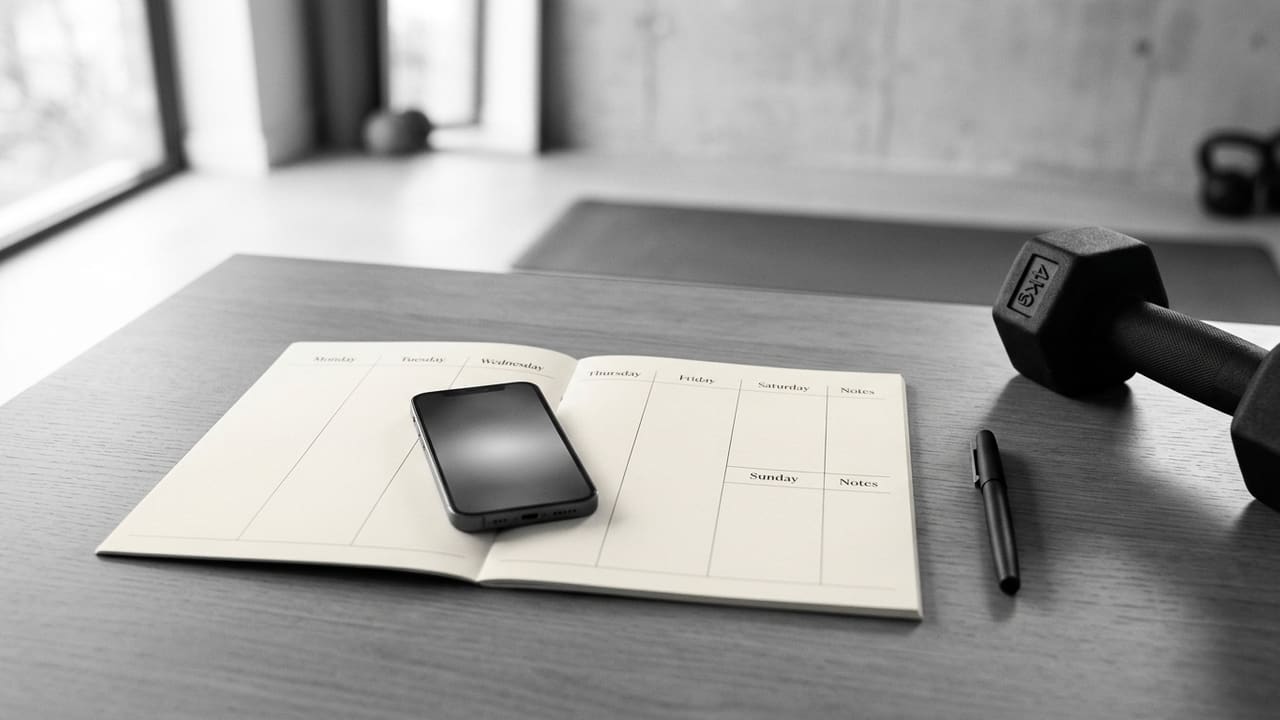
Weekly schedule layout: training and recovery
The ideal full body workout 3 days a week structure places at least one full recovery day between training sessions. This ensures your nervous system and connective tissues fully recover before imposing another full-body stimulus.
| Day | Session | Primary Focus | Target Stimulus |
|---|---|---|---|
| Monday | Workout A | Knee Flexion (Squat) + Horizontal Push/Pull | Heavy compound strength (5–8 reps) |
| Tuesday | Rest | Passive or active recovery (walking, mobility) | Systemic recovery |
| Wednesday | Workout B | Hip Hinge (Deadlift) + Vertical Push/Pull | Hypertrophy volume (8–12 reps) |
| Thursday | Rest | Active recovery, light cardio | Systemic recovery |
| Friday | Workout C | Unilateral Leg + Chest/Back Hypertrophy + Arms | Metabolic stress & isolation (10–15 reps) |
| Saturday & Sunday | Rest | Two consecutive days of full recovery | Nervous system restoration |
Workout A: heavy compound foundation (Monday)
Workout A establishes your weekly foundation with heavy bilateral movements. The session opens with a squat pattern to tax the quadriceps and gluteal complex, followed by heavy horizontal pressing and rowing.
| Exercise | Movement Pattern | Target Muscles | Sets × Reps | Rest |
|---|---|---|---|---|
| Barbell Back Squat | Knee Flexion (Squat) | Quadriceps, Glutes, Adductors | 3–4 × 5–8 | 2–3 mins |
| Barbell Bench Press | Horizontal Push | Chest, Anterior Deltoids, Triceps | 3–4 × 6–8 | 2 mins |
| Chest-Supported T-Bar Row | Horizontal Pull | Lats, Rhomboids, Mid Traps | 3 × 8–10 | 2 mins |
| Romanian Deadlift (Dumbbell or Barbell) | Hip Hinge | Hamstrings, Glutes, Erector Spinae | 3 × 8–10 | 90s |
| Standing Dumbbell Lateral Raise | Shoulder Abduction | Lateral Deltoid | 3 × 12–15 | 60s |
| Standing Calf Raise | Plantarflexion | Gastrocnemius, Soleus | 3 × 12–15 | 60s |
Workout B: posterior chain & vertical focus (Wednesday)
Wednesday shifts emphasis toward the posterior chain with a hip hinge, paired with vertical pressing and pulling to balance shoulder joint mechanics.
| Exercise | Movement Pattern | Target Muscles | Sets × Reps | Rest |
|---|---|---|---|---|
| Conventional or Trap Bar Deadlift | Heavy Hip Hinge | Hamstrings, Glutes, Entire Back | 3 × 5 | 3 mins |
| Overhead Barbell or Dumbbell Press | Vertical Push | Anterior/Lateral Deltoids, Triceps | 3 × 6–8 | 2 mins |
| Weighted Pull-Ups or Lat Pulldown | Vertical Pull | Latissimus Dorsi, Biceps, Teres Major | 3–4 × 6–10 | 2 mins |
| Leg Press or Goblet Squat | Knee Flexion (Assistance) | Quadriceps, Glutes | 3 × 10–12 | 90s |
| Incline Dumbbell Biceps Curl | Elbow Flexion | Biceps Brachii (Long Head) | 3 × 10–12 | 60s |
| Overhead Cable Triceps Extension | Elbow Extension | Triceps Brachii (Long Head) | 3 × 10–12 | 60s |
Workout C: unilateral balance & hypertrophy (Friday)
Friday rounds out the week by addressing unilateral asymmetries, targeting upper-chest fibres, and accumulating metabolic volume across smaller muscle groups before the weekend.
| Exercise | Movement Pattern | Target Muscles | Sets × Reps | Rest |
|---|---|---|---|---|
| Bulgarian Split Squat | Unilateral Knee Flexion | Quadriceps, Gluteus Medius | 3 × 8–10 / leg | 90s |
| Incline Dumbbell Press | Incline Push | Clavicular (Upper) Chest, Triceps | 3 × 8–12 | 90s |
| Chest-Supported Dumbbell Row | Horizontal Pull | Upper Back, Rear Delts | 3 × 10–12 | 90s |
| Seated or Lying Hamstring Leg Curl | Knee Flexion | Hamstrings (Biceps Femoris) | 3 × 10–12 | 60s |
| Cable Face Pulls | External Rotation | Rear Deltoids, Rotator Cuff | 3 × 15–20 | 60s |
| Hanging Leg Raise or Cable Crunch | Spinal Flexion | Rectus Abdominis | 3 × 12–15 | 60s |
Why 3-day full body outperforms traditional body-part splits
For decades, recreational gym-goers followed the “bro split”—training chest on Monday, back on Tuesday, shoulders on Wednesday, legs on Thursday, and arms on Friday. While popularised by enhanced bodybuilders, this approach is mathematically suboptimal for natural lifters.
When you lift, muscle protein synthesis spikes and peaks within 24 hours, returning to baseline by roughly 36 to 48 hours. If you train chest only on Monday, that muscle is actively growing for roughly two days; for the remaining five days of the week, it undergoes zero growth stimulus.
By contrast, a 3-day full-body split hits your chest on Monday, Wednesday, and Friday. Your pectoral muscles experience three distinct growth spikes every single week. Over the course of a training year, a full-body lifter triggers 156 growth opportunities per muscle group, compared to only 52 in a once-per-week split.
Furthermore, splitting 12 weekly chest sets into 4 sets per session ensures every single rep is performed with maximum neural output and minimal cellular fatigue.
Comparing splits: 3-Day Full Body vs 4-Day Upper/Lower vs 6-Day PPL
Choosing the right split comes down to your weekly schedule availability and recovery capacity:
| Split | Weekly Days | Frequency / Muscle | Session Length | Best For |
|---|---|---|---|---|
| 3-Day Full Body | 3 days | 3× weekly | 60–75 mins | Busy professionals, beginners, students, maximum efficiency |
| 4-Day Upper/Lower | 4 days | 2× weekly | 50–65 mins | Lifters wanting distinct upper and lower training days |
| 6-Day Push/Pull/Legs | 6 days | 2× weekly | 45–60 mins | Advanced lifters who love spending every day in the gym |
If you train at home or with limited equipment, check our complete dumbbell only workout plan. If your schedule permits four days, explore our upper lower split guide. If you prefer high-frequency dedicated sessions, check our comprehensive push pull legs split guide.
Building a 3-day split from saved video workouts
You do not have to abandon your favourite fitness creators to follow this routine. If you have saved reels and shorts across TikTok, Instagram, and YouTube, you can easily map them into this 3-day template:
- Identify the core movement in each video: Group your saved clips by movement pattern (squat, hinge, press, pull) rather than influencer titles. Check our muscle anatomy guide if you are unsure which muscles a movement targets.
- Assemble into three balanced days: Place one squat video and one horizontal push video on Monday, a deadlift and pull-up video on Wednesday, and a lunge and incline pressing video on Friday.
- Import directly into Prept: Share the video links to Prept, and our multi-modal AI extracts the exercise details into your weekly workout planner.
- Log on the gym floor: Use Prept’s live workout tracker to log weights and reps while having the source video cued to each exercise between sets.
- Apply progressive overload: Ensure you track your weights and reps each week to guarantee continuous adaptation following our progressive overload guide.
To generate a personalised 3-day schedule tailored to your available gym equipment, try our free workout split generator.
Frequently asked questions
Can you build serious muscle working out only 3 days a week?
Yes. Multiple peer-reviewed studies show that when weekly volume (sets and reps) is equated, training 3 days a week produces identical muscle hypertrophy to training 4, 5, or 6 days. Total weekly hard sets determine growth, not the number of gym visits.
How long should a 3-day full body workout take?
A properly structured 3-day full-body session takes 60 to 75 minutes. This allows 5 to 10 minutes for a dynamic warm-up, 45 to 50 minutes of focused lifting across 5 to 6 core exercises, and adequate 2-minute rest intervals between heavy compound sets.
Won’t I be too sore to train full body again after 48 hours?
Initially, yes, during your first week. However, the “repeated bout effect” rapidly adapts your muscles within 10 to 14 days. Because you perform only 3 to 4 sets per muscle group per session, delayed-onset muscle soreness (DOMS) diminishes dramatically compared to marathon single-muscle workouts.
What should I do on my four rest days?
Engage in active recovery: aim for 8,000 to 10,000 daily steps, perform light mobility work, or complete 20 to 30 minutes of low-intensity zone-2 cardio. Ensure you consume adequate protein and get 7 to 9 hours of sleep to facilitate tissue repair.
How do I apply progressive overload on a 3-day full body routine?
Use the double progression method: select a target rep range (such as 8–10 reps). When you can complete all prescribed sets at the upper rep limit with good form, increase the weight by 1.25kg to 2.5kg the next week and build back up.
The bottom line
Consistency beats complexity. If your busy life makes 5 or 6 gym visits unrealistic, committing to a focused full body workout 3 days a week delivers maximum muscle growth, complete recovery, and sustainable progress for years to come.